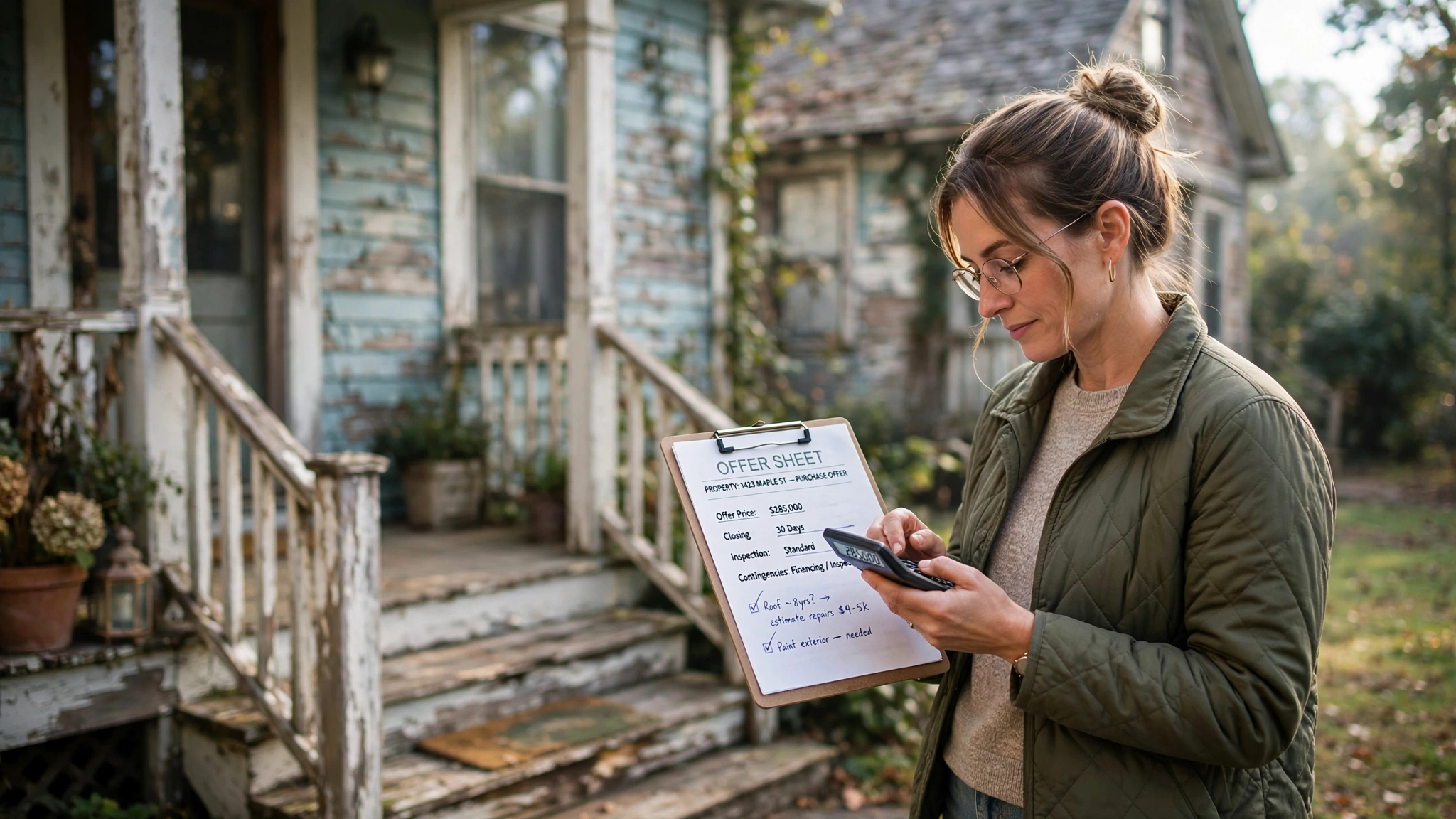
A cash offer can feel like a mystery. You describe your house, a buyer comes back with a number, and you wonder how they got there and whether it is fair. You deserve to understand the math. Once you do, you can compare offers confidently and spot the ones that do not add up.
The Starting Point: What the House Is Worth Fixed Up
Most cash buyers begin with the after-repair value, or ARV: what your house would likely sell for in the local market once it is updated and in good condition. They estimate it by looking at recent sales of similar homes nearby, known as comparables. Size, bedroom and bathroom count, lot, neighborhood, and how recently each home sold all matter.
Good comps are recent, close by, and truly similar. A buyer who pulls sales from a different part of town, or from a different year, may land on the wrong number.
Subtract the Work the House Needs
Next, the buyer estimates the cost to bring the house up to that ARV. This includes obvious items such as roof, kitchen, flooring, and paint, and less visible ones such as foundation, plumbing, electrical, HVAC, mold, or code violations. When you sell as-is, you hand that work and its risk to the buyer, which is the whole point of an as-is sale.
Account for the Buyer's Costs
A buyer who purchases, repairs, and resells a house carries costs that you avoid when you sell directly: financing or the cost of tying up cash, property taxes and insurance while they hold the house, utilities, closing costs on both ends, and the time it takes to finish and resell. They also build in a margin for the risk that repairs run over or the market shifts.
A Simple Illustration
Many investors use a rule of thumb: ARV × a target percentage − repair costs. The percentage varies by buyer and market. As an illustration only, with an ARV of $250,000, a 70% target, and $40,000 in repairs, the math is $250,000 × 70% = $175,000, minus $40,000 = $135,000. Your house, your market, and each buyer's approach will produce different numbers. The takeaway is the structure: value, minus repairs, minus the cost and risk of doing the project.
Compare the Offer to Your Real Alternatives
A fair comparison looks at what you keep, not just the headline price. Traditional sales usually involve agent commissions, which are commonly around 6% of the sale price, plus repairs, cleaning, staging, closing costs, and months of mortgage, tax, and utility payments while the house sits on the market. A cash sale with no commissions, no fees, and no repairs can leave you with a similar or better net amount in a fraction of the time, especially when the house needs significant work.
That is not true for every house. A home in excellent condition in a hot market may net more through a traditional listing. Run both scenarios before you decide. Our guide on cash offer vs realtor net proceeds shows how to line them up.
Questions to Ask Every Cash Buyer
- Is this a firm offer in writing? You want a written offer, not a verbal range.
- Who is buying the house? Make sure the company is purchasing it directly, not shopping your contract to someone else without telling you.
- What fees or closing costs will I pay? Get every line item.
- How did you arrive at this number? A trustworthy buyer can explain the comps and repair assumptions.
- Can you show proof of funds? A bank letter or statement shows they can close.
- What is the closing timeline, and can I choose it? Flexibility matters if you need more time to move.
- Is there a re-trade clause or an inspection contingency? Ask how and when the price can change after you sign.
Red Flags
- Pressure to sign today, with no time to review the contract.
- Upfront fees, or a requirement that you pay for anything before closing.
- An offer that changes significantly after the walkthrough without a clear explanation.
- Vague answers about who the buyer is or where the money comes from.
Read more in our guide to finding a legitimate cash home buyer.
How We Build Our Offers
At Fair Price Home Buyers, honesty is our North Star. We base our offers on current market data and the condition of your property, and we give you a fair, no-obligation cash offer within 24 hours of receiving your details. We buy houses as-is, so you do not clean, repair, or stage anything. There are no commissions and no fees, and you can close in as little as 7 days or on your timeline. We buy in all 50 states.
If you want to see how your house stacks up, request your no-obligation cash offer. You can compare it against any other offer, or a traditional listing, and choose what works for you.
The Bottom Line
A cash offer is value minus work minus the cost and risk of the project. When a buyer explains each piece and puts the number in writing, you can judge it fairly. Ask for the breakdown, compare your options on what you actually keep, and take the time you need to decide.
